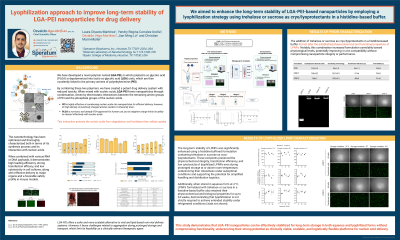
Lyophilization approach to improve long-term stability of LGA-PEI nanoparticles for drug delivery
Introduction: Polymer-based nanoparticles offer a promising platform for nucleic acid delivery; however, their clinical application is often hindered by storage instability, limiting their therapeutic potential1,2. Lactic-co-glycolic acid-polyethylenimine (LGA-PEI)-based nanoparticles (LPNPs) demonstrate high transfection efficiency with low toxicity in vitro while ensuring robust delivery and safety in vivo3,4. This study evaluates a lyophilization strategy to enhance LPNP stability, addressing key storage challenges and improving their functionality, viability, and applicability in nucleic acid delivery
Learning Objectives:
Evaluate key factors influencing the stability of delivery systems for therapeutic applications.
Compare different strategies for enhancing the long-term stability of nanoparticle formulations.
Assess the impact of storage conditions on nanoparticles using advanced characterization techniques.
Laura Chaves-Martínez – Lead Scientist, Nanotechnology, Speratum Biopharma, Inc., Newark, DE 19702, USA; Yendry R. Corrales-Ureña – Lead Scientist, National Laboratory of Nanotechnology (LANOTEC), National Center for High Technology (CeNAT), San José 1174-1200, Costa Rica; María-José López-Brenes – Lead Scientist, Cell Culture, Speratum Biopharma, Inc., Newark, DE 19702, USA; Jian-Ming Lü – Lead Scientist, Michael E. DeBakey Department of Surgery, Baylor College of Medicine, Houston, TX 77030, USA; Christian Marín-Müller – CEO, Speratum Biopharma, Inc., Newark, DE 19702, USA